Choosing a health care agent and primary physician ensures your medical wishes are honored when you can't speak for yourself. Here's how to select the right people and have important conversations about your care.
Choosing a health care agent—also known as a health care proxy, medical proxy, representative, or surrogate—is a crucial step in documenting your health care wishes. This person will collaborate with your primary care physician and other medical providers to make treatment decisions for you if you cannot speak for yourself.
If you have someone you trust to do this job, appoint a health care agent and at least one alternate agent. Naming someone to oversee your care and advocate on your behalf greatly increases the chances that your health care preferences will be honored.
In your advance health care documents, you can also name a primary physician to oversee your care. This is recommended if you have a trusted doctor with whom you’ve discussed (or can discuss) your health care preferences.
This article explains how to select and appoint the right people for these critical roles.
In This Article
- What Is a Health Care Proxy?
- What Does a Health Care Proxy Do?
- What Are a Health Care Proxy’s Legal Responsibilities?
- Choosing a Health Care Proxy or Agent
- Talk to Your Health Care Agent
- How to Appoint a Health Care Agent
- What Is a Primary Physician?
- Choosing a Primary Physician
- Naming Non-Physician Primary Care Providers
- More Information About Advance Health Care Planning
What Is a Health Care Proxy?
A health care agent or proxy is someone you choose to make medical decisions for you when you can't make them yourself. Your agent speaks for you when you're unable to communicate due to illness or injury. They work with your doctors to make sure you receive care that aligns with your wishes and values. Their authority begins only when you are truly unable to speak for yourself.
Your health care proxy is different from your primary physician. Your doctor has the medical knowledge and explains your treatment options. Your proxy knows you—what matters to you, what you would want, and what you would refuse. Your agent doesn't need any medical training. When the time comes, these two will ideally work as a team: your doctor presents the medical facts, and your proxy makes decisions based on what you would have wanted.
What Does a Health Care Proxy Do?
If you become unable to direct your own health care, your agent will supervise any treatment instructions you’ve set out in your health care documents and make decisions about matters your documents don’t cover. Your health care directives can give your agent very broad authority to direct your medical care, or you can fine-tune your document by granting specific powers.
To carry out your wishes and make decisions for you, your agent will almost always have the authority to:
- review your medical records
- authorize necessary treatments
- visit you in any health care facility, and
- hire or fire medical staff.
If necessary, your agent can even go to court to ensure your wishes are followed. These powers give your agent what they need to make sure your health care preferences are honored. If a facility or doctor won’t comply, your agent can arrange a transfer to someone who will.
What Are a Health Care Proxy’s Legal Responsibilities?
You might worry that naming a health care agent means giving up control of your medical treatment, but that's not the case. Your agent is legally required to follow your known wishes and act in your best interest. If you leave written instructions, both your agent and your health care providers must follow them. However, you can also choose to leave certain decisions entirely to your agent's judgment.
Your proxy’s decisions must always align with what you’ve directed in your health care documents and any other wishes you’ve communicated. If your proxy doesn’t know your specific wishes in a situation, they must decide what they believe you would choose if you were able.
To ensure you get the care you want, talk with your agent and other loved ones about your wishes. (For tips, see Talk to Your Agent, below.)
What happens if your proxy lets you down? If someone proves in court that your proxy is acting against your wishes, the court can revoke their authority. Your named alternate would then take over. If you haven't named an alternate or they're unavailable, the court will appoint a guardian or conservator to make your health care decisions.
Choosing a Health Care Proxy or Agent
When selecting a health care proxy, pick someone you trust and with whom you feel comfortable talking about your wishes. They should respect your right to the medical care you want, even if they don't fully agree with your choices.
You can choose your spouse, partner, relative, or close friend. Your agent might need to stand up for your wishes against medical staff or family members who have their own beliefs. If you expect conflict, choose someone strong-willed and assertive. Your agent doesn’t need to live in your state, but proximity is worth considering. During a long illness, they might need to spend weeks or months at your bedside ensuring providers follow your wishes.
If you have (or plan to make) a durable power of attorney for finances, consider naming the same person for both roles. If you choose different people—perhaps one is better with finances and the other better at your bedside—remember they'll need to work closely together. For example, your financial agent will pay medical bills at your health care agent's direction.
If you can't think of anyone you trust, skip naming an agent. It's better to name no one than someone who won't advocate strongly for you. Still, put your wishes in writing—medical personnel must follow them or find someone who will. If you don't have an agent, do consider naming a primary physician, discussed below. You should also discuss your wishes directly with your doctor or with the patient representative at any facility where you receive care.
Who Can Be a Health Care Agent?
Most people choose a family member, trusted friend, or close advisor as their health care agent. Your agent must be a legal adult (18 in most states) and of sound mind.
Many states restrict who can serve to avoid conflicts of interest. Your doctor and other health care providers usually cannot serve—they might have financial or professional interests that conflict with your wishes. You also generally cannot choose:
- the owner or operator of a health or residential care facility where you receive treatment, or
- any employee of your health care provider.
That said, there’s usually an exception for people in these categories who are close relatives.
Check your state's rules to learn who can serve as an agent. Contact your state legal aid office or bar association for current information. Reputable estate planning programs also provide up-to-date state requirements.
Choosing Alternate Agents
You should name one or two alternate health care proxies. Your first alternate serves if your primary choice is unavailable. Your second alternate takes over only if both your primary proxy and first backup can’t or won’t serve, or can’t be reached quickly. Choose your alternates using the same criteria as your primary agent: trustworthiness, dependability, assertiveness, and availability. Make sure any backup you choose is legally allowed to serve in your state.
Don’t Name More Than One Agent
You should name only one person at a time to serve as your agent. Naming two people to serve together is usually a bad idea, even if both are willing. When critical decisions need to be made, co-agents might disagree or have a change of heart, making them unable to effectively advocate for you while they're in conflict. If you’re considering two people, choose one as your primary agent and the other as your backup.
Talk to Your Health Care Agent
Talking about end-of-life medical care isn't easy, but it's one of the most important conversations you can have. Most people who take this step find it worthwhile—and often feel relieved to have their wishes known. Start by talking with your agent, then extend the conversation to close family members and friends if you can. If you're not sure how to begin, try using a relevant news story, television show, or film as a conversation starter.
When talking with your agent, focus on three goals:
- Confirm they're willing to take on this responsibility.
- Share your written instructions and other wishes.
- Answer questions so you're both clear about what you want.
Your agent might raise issues you haven't thought about. Use this as an opportunity to clarify your understanding so you both feel confident that your agent will know what to do if you can't speak for yourself.
If you have a primary care provider, consider arranging for your doctor and agent to meet. If you’re already in a medical facility, your agent should also connect with the social worker or patient representative.
Why are these conversations so important? First, they let people know you’re creating health care documents and why this matters to you. Second, no document can anticipate every possible medical situation. Sharing your values and personal views helps prevent future disagreements about how your written wishes should apply to specific circumstances.
When discussing your values, consider covering:
- your overall attitude toward life—what gives you purpose and meaning, and how you feel about independence
- fears about losing the ability to speak for yourself or make your own decisions
- strong feelings about specific medical treatments at the end of life, such as life support or feeding tubes
- where you’d prefer to be at the end of your life (at home, in hospice, or in a hospital)
- what phrases like "death with dignity" or "no heroic measures" actually mean to you
- spiritual or religious beliefs that affect your feelings about serious illness and death
- what you want for comfort when you’re close to death (certain people present, music, being read to)
- your feelings about doctors and caregivers in general, and any opinions about specific providers, and
- what you want after death, including organ donation, autopsy, and final arrangements (burial, cremation, memorial services).
These conversations aren’t always easy, but they offer everyone involved greater peace of mind. Your loved ones will know your true wishes, and you may find that the discussion brings clarity, understanding, and closer relationships.
How to Appoint a Health Care Agent
You can formally appoint a health care agent or proxy using various legal documents. Terminology varies by state, and the documents serve slightly different purposes, but they each give someone the legal authority to make medical decisions for you if you can’t speak for yourself.
Advance directive (health care directive): Most advance directive forms allow you to appoint a health care proxy and describe your treatment wishes. As long as your document is properly finalized, the appointment of your health care proxy in an advance directive is legally binding.
Health care power of attorney (health care proxy). These documents allow you to name your proxy, but generally don’t include your health care wishes. You can use a power of attorney for health care to give someone broad authority to speak for you. Many people use a power of attorney in conjunction with a second document describing their health care wishes, such as a living will.
Whichever document you use, the most important thing is to have open conversations with your agent about your values and preferences. No document can anticipate every possible medical situation, so your agent’s understanding of what matters to you is essential.
What Is a Primary Physician?
When you make a health care directive, you can name a primary physician. This is the doctor who will oversee your medical care and make legally important decisions about your mental capacity and health status when needed.
Consider naming a primary physician if you have an established relationship with a doctor you trust and with whom you can discuss your health care preferences. If you don't have such a relationship, you can skip this step and leave it to your health care agent to choose the best doctors if needed.
A primary physician plays two key roles. First, they determine when your health care documents should take effect. For example, your documents become active if you lack the capacity to make your own health care decisions, and your primary physician decides whether that time has come.
Second, a primary physician diagnoses specific medical conditions that trigger different sets of instructions in your documents. You might leave one set of instructions for permanent unconsciousness and another for terminal illness. (For more information, see Advance Care Planning for Different Medical Conditions.) Your primary physician will identify which condition applies, activating the appropriate instructions.
Choosing a Primary Physician
If you have multiple doctors, choose the one best suited to oversee your overall care. This is often your family doctor or general practitioner rather than a specialist. If you're uncertain, talk with each doctor you're considering. You may discover that one is more comfortable taking on this responsibility, which can help guide your decision.
You can also name one doctor as your primary physician and another as an alternate.
Choosing an Alternate
Consider naming an alternate physician as well. Choose your alternate with the same care as your primary choice, keeping in mind they may need to make critical decisions about your care. If you don't have a second doctor you know and trust, you can skip this step.
Talking to Your Doctor
Talk with your primary care provider about your treatment preferences before finalizing your health care documents. This conversation is especially important because your primary physician will coordinate with other caregivers. Make sure your provider understands and is willing to follow your wishes. If you have questions about specific treatments or concerns about how a medical condition might affect you, discuss those as well.
Let your primary physician know you're creating a health care directive. If you're naming an agent, make sure your physician has their contact information for emergencies. Even better, introduce your agent and doctor if you haven't already done so.
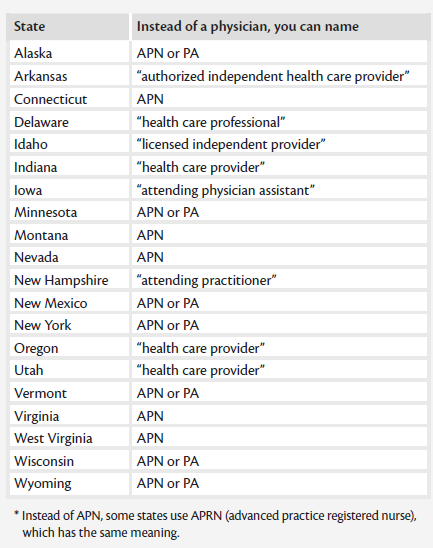
Naming Non-Physician Primary Care Providers
In many states, you can name a non-physician primary provider to oversee your medical care. For example, some states allow you to designate an advanced practice nurse (APN)* or physician's assistant (PA) as your primary care provider. See the chart below. This trend recognizes that the provider who knows you and your condition best may not always be a doctor.
More Information About Advance Health Care Planning
Taking the time to name a health care agent and primary physician is one of the most important steps you can take to ensure your medical wishes are honored. These decisions give you control over your future care and provide peace of mind for you and your loved ones. By choosing the right people and having honest conversations with them, you create a clear path forward during what might otherwise be a difficult and uncertain time.
For more information, see the following articles:
- Advance Health Care Planning: Specifying Your Wishes
- Advance Care Planning for Different Medical Conditions
- Expressing Organ Donation Wishes in Your Health Care Directive
- Power of Attorney for Health Care: What Powers Can You Grant?
You can learn more about using WillMaker to make health care directives in WillMaker’s Legal Manual.
In This Article
- What Is a Health Care Proxy?
- What Does a Health Care Proxy Do?
- What Are a Health Care Proxy’s Legal Responsibilities?
- Choosing a Health Care Proxy or Agent
- Talk to Your Health Care Agent
- How to Appoint a Health Care Agent
- What Is a Primary Physician?
- Choosing a Primary Physician
- Naming Non-Physician Primary Care Providers
- More Information About Advance Health Care Planning