Understand Uniform Transfers to Minors Act (UTMA) custodianships, their advantages and drawbacks, and tips for selecting the ideal UTMA account custodian.
The Uniform Transfers to Minors Act (UTMA) is a model law adopted in substantially the same form in every U.S. state. It allows you to name a custodian to manage property you leave to a minor. The management ends when the minor reaches age 18 to 30, depending on state law.
Many people who create a will or a revocable living trust use either the UTMA or a child’s trust to establish property management for young beneficiaries. This article discusses the UTMA, explains how it works, and offers tips for choosing a child’s property custodian.
How Does a Uniform Transfers to Minors Act (UTMA) Custodianship Work?
In your will or living trust document, you name someone to serve as custodian for a young beneficiary. That person manages any trust property the young beneficiary inherits until the beneficiary reaches the age at which state law says the custodianship must end. Here’s an example of the type of language that might be included in a will using the UTMA:
All property left in this will to Hazel James shall be given to Jane Evans as custodian under the Illinois Uniform Transfers to Minors Act, to be held until Hazel James reaches age 21. If Jane Evans is unwilling or unable to serve as custodian of property left to Hazel James under this will, Jeffrey Chen shall serve instead.
The custodian will establish an UTMA account to hold assets for the beneficiary. UTMA custodial accounts can hold a wide variety of assets, including cash, stocks, bonds, mutual funds, real estate, and other property. While there are no direct limits on contributions to an UTMA account, amounts above the annual federal gift tax exclusion may have tax consequences, and all contributions legally belong to the child. If you have questions about contributions, consult a tax professional or an experienced attorney.
The UTMA custodian will manage the account and make decisions regarding the child’s assets until the child reaches the age specified by state law. Typically, this is 18 or 21, but some states allow you to specify an age within a range, such as 18 to 21 or 21 to 25. Once the child reaches the specified age, the assets must be transferred to them, and they gain full control of the account.
What Are an UTMA Custodian’s Responsibilities?
A custodian is responsible for managing the beneficiary’s property carefully and honestly, following the state’s UTMA rules. Unlike some other property arrangements for minors, a custodian’s actions are not subject to direct court supervision.
The custodian’s main duties include:
- managing the property until the beneficiary is legally entitled to receive it outright
- using the assets or income to pay for the beneficiary’s support, education, and health care
- keeping the minor’s property separate from personal assets, and
- maintaining accurate records of all transactions.
UTMA taxation is relatively straightforward. Income from the custodial property can be reported on the beneficiary’s own tax return. (This differs from a child’s subtrust, which requires a separate tax return.) If necessary, the UTMA custodian may use custodial funds to hire professional help, such as accountants or tax attorneys, and may receive reasonable compensation for their services, if permitted by state law.
How to Choose an UTMA Custodian
Selecting the person who will manage your children's finances is nearly as significant as deciding who will care for them if you die. Many people select the same person for both responsibilities. It is usually preferable to combine the personal care and property management functions for a particular minor child in the hands of one person. Start by considering who would likely be responsible for your children’s care, and then decide if that individual is also a suitable choice for managing their assets. If you do need to select separate people, try to pick individuals who work well together; they will have to collaborate.
It’s important to select someone trustworthy, with experience handling the types of assets you intend to leave to your children, and who shares your values about how those resources should be used. Ideally, this person will live nearby or be willing to travel if necessary. You must designate a person as the custodian under the UTMA—institutions cannot serve in this role.
Don’t feel pressured to find a financial expert for this job. The custodian has the authority to hire professionals to perform tasks such as preparing reports, filing tax returns, or providing investment advice, with their fees paid from the managed assets. The custodian’s primary responsibilities are to manage the property honestly, make sound decisions about the assets, and distribute funds to the beneficiary as needed.
While naming an alternate custodian isn’t required, it’s highly recommended. If your first choice is unavailable and you haven’t named a backup, a judge will appoint someone, which may be costly and will remove your ability to influence the selection. The same criteria you use for your primary custodian should also apply to your alternate.
Whoever you select as custodian, it’s important to obtain their consent beforehand. This also provides an opportunity to discuss your general expectations for how the property should be managed, ensuring the person you choose understands your wishes and appreciates the beneficiary’s needs.
When Does a Uniform Transfers to Minors Act Custodianship End?
When the beneficiary reaches the age you specify, they will receive the remainder of the gift directly, and the custodianship will end. In some states, this age is predetermined. In others, you—the person establishing the custodianship—have the flexibility to select an age within certain limits.
In most states, an UTMA custodianship terminates when the beneficiary turns 21, though some states set the age at 18 or 25. If you prefer that the beneficiary not receive the assets at such a young age, you might consider setting up a trust instead.
The following table shows the UTMA age rules by state:
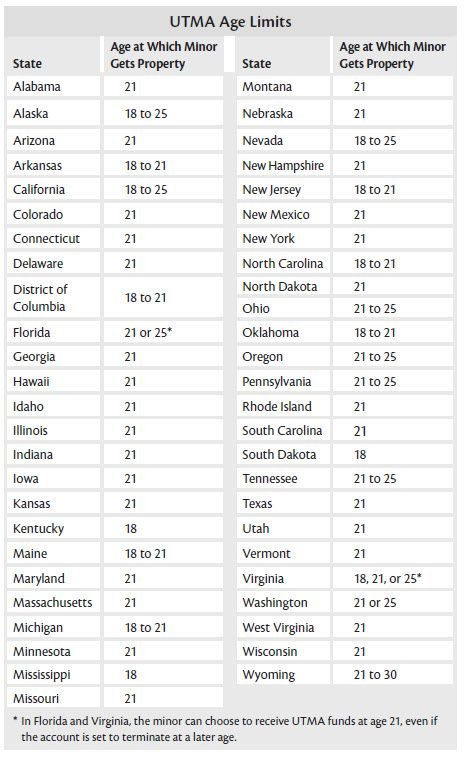
If your state permits you to choose the age at which the custodianship ends, take into account factors such as the amount of money involved, the beneficiary’s expected maturity at that age, and how complex the asset management will be.
If you want the beneficiary to receive the property at an older age than your state’s UTMA allows, consider establishing a child’s trust instead. With a trust, you can arrange for property management to continue until the beneficiary reaches age 35.
Learn More About Wills and Estate Planning
Establishing an UTMA custodianship is an effective way to transfer assets to a child and ensure that those assets are well-managed in the future. That said, it’s important to understand the legal and tax implications, as well as limits on the control and distribution of the assets. With careful planning and the right choice of custodian, an UTMA account can provide valuable support for a young person’s future needs.
The following articles can help you learn more about wills and estate planning:
- Naming a Child’s Guardian
- What Is a Special Needs Trust?
- Naming a Pet Guardian in a Will or Trust
- Property Managers for Children's Inheritance
You can find out more about making WillMaker’s will and living trust in WillMaker’s Legal Manual.