Consider the steps for planning what happens to your body after you die. Should your body be buried or cremated? Do you want a funeral or other ceremony? Who will pay for these plans, and with what money?
Most people would rather not think about their own mortality, but planning your final arrangements can be a great help to you and your loved ones. By making some of these decisions now, you can ease the stress on your family during a tough time, ensure your wishes are carried out, and give everyone peace of mind.
Final expenses can easily exceed $10,000 and often come when families are least ready for them. By understanding the costs of burial, cremation, and other arrangements, and making a plan to pay for them, you can help reduce your family’s financial burden and leave more of your estate as an inheritance.
In This Article
- What Is Pre-Planning a Funeral?
- Step 1: Choosing the Type of Service You Need
- Step 2: Deciding on Mortuaries and Cremation Facilities
- Step 3: Finalizing the Disposition Method (Burial vs Cremation vs Other Options)
- Step 4. Decide About Headstones, Monuments, or Burial Markers
- Step 5: Pre-Paying Funeral Expenses
- Sharing Your Plans
- More Information About Estate Planning
What Is Pre-Planning a Funeral?
Pre-planning your final arrangements involves making decisions about what will happen in the days after you die--so that your loved ones won't have to wade through these decisions when you have just died. When pre-planning, you’ll want to consider:
- what kind of service to have (if any)
- where your body should be prepared -- in a specific mortuary or cremation facility (or possibly at home
- whether your body should be buried or cremated (or something else)
- what marker should indicate your final resting place, and
- who will pay for these plans, and with what money.
Here is more about each of those steps.
Step 1: Choosing the Type of Service You Need
Most deaths are honored by one or more ceremonies. When planning your final arrangements, consider the types of services that might occur before, during, or after burial or cremation. You might want ceremonies at all of these times, just one, or none at all. Here we introduce some different types of ceremonies, including wakes, funerals, and scattering services, and their average costs.
Viewing, Visitation, or Wake
Most people want to have at least one ceremony or gathering before burial or cremation, even if it’s simple. A wake or funeral lets friends and family say goodbye, support each other, and start to grieve.
However, there may be valid reasons to skip this type of ceremony. If you live far from most friends and family, requiring them to travel on short notice could create significant hardship. In such cases, many people forgo a traditional funeral in favor of a memorial ceremony held days or weeks later, allowing more people to attend. You can also request both a small gathering before burial or cremation and a larger memorial ceremony afterward.
A viewing, visitation, or wake gives family and friends the opportunity to see your body and spend time with you after death. For some, it's a quiet, reflective occasion. For others, it's a gathering to remember and honor your life with loved ones.
Planning a viewing, visitation, or wake. Viewings and visitations are typically held at funeral homes or mortuaries, but you can also hold them at your home, a community hall, or a place of worship, depending on your preferences and what’s available.
Traditionally, a wake is both a time of sadness and a celebration, honoring the person’s life and saying goodbye. Wakes are often held at home, but many funeral homes now offer space for one- or two-day wakes. Wakes can help family and friends come together and support each other.
If you want a viewing, visitation, or wake, consider:
- where and when to hold the gathering
- who should be invited
- whether you will have a casket and, if so, whether it should be open or closed, and
- whether you want music, readings, certain types of food or drink, or other details for the gathering.
For wakes, there is, of course, no limit to the number of details you could specify. Some people have requested that guests wear festive attire, share favorite stories, or play meaningful music.
Costs of a Viewing, Visitation, or Wake
The location and choice of services will determine the costs of these rituals. The fee for using a viewing room in a funeral home will range $200 to $500. If the viewing will take place over a number of days, embalming may be required, which will typically cost $500 to $800. Preparing the body ($200-$400), casket rental ($900-$1,200), refreshments, and printed materials will incur additional fees. All of this can add up, making a simple funeral visitation cost $500 to $1,000. A more elaborate event could cost many thousands of dollars.
Funeral
A traditional funeral is a short pre-burial ceremony at a funeral home or place of worship. The body is often present in an open or closed casket. Other than that, there aren’t strict rules about what a funeral must include. For people of faith, funerals often have a mass, blessing, or prayer service.
In some traditions, funerals are private family events, while friends and others are invited to separate ceremonies. In other cultures and traditions, funerals are a more public gathering.
Planning a funeral. When deciding what you want, consider:
- where the ceremony should be held
- who should be invited
- whether clergy should lead or participate in the ceremony, and specific names of clergy members you prefer
- music selections and preferred musicians or singers to perform them
- preferences for eulogies or readings, and who you’d like to deliver them
- whether you want your body present or a photograph displayed instead, and
- whether you’d prefer memorial donations to a specific organization in lieu of flowers.
If you want family and friends to gather for a reception after your funeral, you can include that in your plans. Besides choosing where to hold the reception, you might also want to think about these details:
- who should be invited
- what kind of food and beverages should be served, and
- whether you want specific music, activities, or entertainment.
Paying for a funeral. The cost of your funeral will depend on the location and what services you want. According to the National Funeral Directors Association, the average cost of a funeral is about $8,300 to $10,000. This should include the funeral director’s fee ($2,000-$3,000), a rental fee for the ceremony space ($400-$600), and transportation ($300-$500), and any food or reception costs. Separately, the cemetery may charge additional fees. To get a better idea of your costs, contact several funeral homes and ask for an itemized list. While you’re at it, ask about prepaid plans, but don’t feel obligated to buy one without thorough research and comparison.
Burial, Interment, or Scattering Ceremony
In addition to or instead of a pre-burial ceremony in a home or place of worship, many people hold a brief graveside service where a religious leader, relative, or close friend offers prayers or words of farewell. Similar ceremonies are also common when ashes are scattered or interred after cremation.
Planning a burial, internment, or scattering ceremony. If you want this type of ceremony, think about who should attend, who should speak, and what should be said.
Costs of a burial, interment, or scattering ceremony. Costs will vary depending on location and what services you want. A funeral home will usually charge fees for organizing and staff services, and you may need to pay for transportation to the site and officiant fees. All of these fees can add up to many hundreds of dollars. Of course, holding such ceremonies without clergy or help from a funeral home can save a lot of money.
Ceremonies After Burial or Cremation
Post-burial or post-cremation ceremonies can range from an immediate reception following burial or ash scattering to memorial services held days, weeks, or months later. Memorial ceremonies can take place anywhere—at a funeral home, place of worship, private home, outdoor location, or even a restaurant.
Memorial ceremonies are often chosen by those seeking a simpler, more economical commemoration. While funeral directors, grief counselors, and clergy may participate in memorial ceremonies, they may not provide the most objective advice about your options.
Although some people believe that traditional funerals are the best way to help survivors grieve, even though they often cost more and may feel less personal. But it may also be true that mourners will find the most comfort in ceremonies that truly reflect the wishes and personality of the person who has died.
The planning considerations for post-burial or post-cremation receptions and memorial ceremonies are similar to those for wakes and funerals, discussed above. Costs for memorial services vary widely depending on whether you use a funeral home facility or hold the event at a private location, but they’re generally more affordable than traditional funerals since they don’t involve body preparation or immediate time pressures.
Step 2: Deciding on Mortuaries and Cremation Facilities
Choosing a funeral home or cremation facility is one of the biggest financial decisions in your final planning. If you research your options and compare providers now, you can help your loved ones make informed choices. Still, it’s smart to give your family some flexibility, since things can change over time. You might move, or a facility could close. Leaving some room for changes in your plans helps make sure your wishes can still be honored.
A full-service funeral home can handle many aspects of final arrangements, including:
- transporting the body from the place of death
- storing the body until burial or cremation
- making arrangements for burial or cremation
- conducting funeral ceremonies
- preparing the body for viewing, burial, or cremation, and
- arranging to have the body transported for burial or cremation.
Funeral homes also assist with administrative tasks, such as preparing obituaries and obtaining death certificates. Many cremation facilities offer similar comprehensive services.
Choosing a Facility
Finding a funeral home or cremation facility that meets your needs in terms of service style, location, and cost is an important part of planning. Comparison shopping is straightforward because federal law requires funeral homes and cremation facilities to provide itemized price lists to anyone who requests them, either in person or over the phone.
Compare prices and services from several local facilities before making your decision. Funeral consumer groups or memorial societies may be able to help locate reputable providers and make informed planning decisions. You may need to become a member, but the fees are usually small. With your membership, you’ll get access to local resources, and you might get discounts on funeral products or packages.
To start, try the Funeral Consumers Alliance at www.funerals.org or 802-865-8300. To learn more about cremation options, contact the Cremation Association of North America at www.cremationassociation.org or 312-245-1077.
Making Independent Plans
A growing number of Americans are choosing to care for their own deceased family members, minimizing or eliminating the involvement of funeral industry professionals. This can include preparing the body, conducting home funerals, handling burial on private property, or transporting the body to a cremation facility.
Families can legally handle final arrangements independently in most states, though state regulations govern how this must be done. For example, most states have laws specifying burial depth requirements and other safety standards. A licensed funeral director may need to be involved for some aspects of dealing with the body.
These resources can provide more information if you might want your family and friends to handle your final arrangements.
- Funeral Consumers Alliance: Offers extensive resources for planning independent arrangements (www.funerals.org).
- Final Rights: Reclaiming the American Way of Death by Joshua Slocum and Lisa Carlson (Upper Access, Inc.): A comprehensive guide to funeral planning written by leading consumer advocates, with detailed information, practical examples, and state-by-state legal requirements.
- National Home Funeral Alliance: Provides information, guidance, and resources specifically for home funerals (www.homefuneralalliance.org)
- Nolo.com: Offers state-specific information about home funeral laws and regulations.
If you want to get state-specific information about legal requirements from the source, contact your state health department or the agency that regulates cemeteries and funeral services. You might start with an online search for your state name plus "health department" or "funeral regulations" to find the appropriate agency.
Step 3: Finalizing the Disposition Method (Burial vs Cremation vs Other Options)
One of the most important decisions when planning your final arrangements is choosing between burial and cremation. Below is an overview of both options, including the cost of cremation vs. burial.
Planning and Paying for Burial Costs
While cremation is becoming increasingly common, most people still choose to be buried. Depending on the deceased person’s wishes, a body may be buried immediately after death or several days later, after a funeral or other memorial service.
The burial process. Bodies can be buried in the ground in a cemetery plot or placed aboveground in a mausoleum or family crypt. While burial typically involves a casket, immediate burial may not. Note that while many cemeteries require caskets, U.S. law does not mandate them.
Burial Costs. Burial costs can add up quickly. A traditional funeral with burial and headstone averages more than $10,000. Depending on the products, services, and ceremonies you choose, burial expenses can be several times higher than cremation.
Typical burial costs include:

What Is Cremation and How Much Does Cremation Cost?
Almost half of Americans now choose cremation instead of burial. Many people pick cremation because it costs less, but others like the idea of having their ashes scattered in a special place or kept by family at home.
Cremation uses high heat to turn a body into fine ash and bone fragments. These remains, sometimes called cremains but more often called ashes, can be buried, scattered, or kept in an urn. Cremation requires a temporary container, usually made of unfinished wood, cardboard, pressboard, or canvas, which the facility provides.
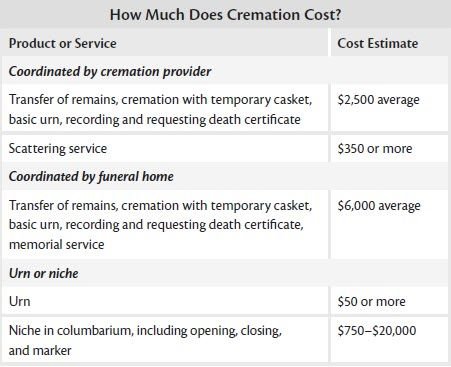
Full cremation services usually cover transporting the body to the facility, a viewing or visitation, the temporary container, the cremation, a memorial service, preparing the obituary, filing the death certificate, and handling the ashes afterward.
Cremation Costs. How much does cremation cost? Typical expenses include:
What to do with cremated remains? If you choose cremation, consider what you'd like done with your ashes. Options include:
- scattering over land or water
- burying
- storing aboveground, or
- keeping with family or friends.
If you'd like your ashes divided among multiple options, you can specify how they should be distributed and prioritize which arrangement is most important to you.
Scattering or Burying Ashes. If you choose to have your ashes scattered or buried, be aware that state or local laws may affect your wishes.
Many people want their ashes scattered in a special place, like a garden, scenic spot, or body of water. But laws about scattering ashes are different in each state. Check with a local cremation facility or your state health department to find out what’s allowed where you live.
If it applies to you, you should also check state and local laws regarding the burial of ashes. Ashes can be buried in the ground. Local zoning ordinances may restrict where burials may take place, such as requiring burials to be a specified distance from a residence.
Nontraditional Options
There are increasing numbers of nontraditional burial or cremation options. The availability and costs of these options vary widely depending on the process and the location.
Green Options for Traditional Burial or Cremation. Traditional burial and cremation can have significant environmental impacts. Embalming chemicals, metal caskets, concrete vaults, and cremation emissions all take a toll on the environment. Fortunately, you can choose eco-friendly alternatives that reduce your environmental footprint. Many of these options are simpler and less expensive than traditional methods:
- Skip embalming. Embalming fluid contains toxic chemicals, including up to three gallons of formaldehyde per body. Embalming is rarely required by law and is often unnecessary to fulfill final wishes.
- Choose an eco-coffin or biodegradable urn. You can use a simple wooden casket, a cardboard box, or a fabric shroud for burial. There are many options for biodegradable coffins and urns (for ashes that will be buried), including homemade ones.
- Have a home funeral. While it's more work, your loved ones might find a home funeral to be more satisfying. Most states permit home funerals, but a handful require a funeral director's involvement.
- Decline burial vaults. Vaults are concrete containers placed in the ground to surround caskets. While not legally required, many cemeteries require them to facilitate easier landscape maintenance. Seek out cemeteries that don't require vaults or inquire about your right to refuse one.
- Select a green cemetery. The Green Burial Council certifies cemeteries committed to environmentally friendly practices. Find certified facilities at www.greenburialcouncil.org.
- Explore conservation burial. Some protected lands offer burial services that combine sustainable practices with land conservation for future generations while allowing current use by the living. Learn more at the Conservation Burial Alliance website: www.conservationburialalliance.org.
Traditional funeral homes might not know much about these eco-friendly options. If you’re interested in any of them, look up providers and costs, and give your loved ones clear instructions about where and how to arrange the services you want.
Innovative Options
Innovative methods of body disposition continue to emerge, offering alternatives to traditional burial and cremation. Here are some noteworthy options:
- Aquamation. This water-based cremation process uses a solution of water and potassium (or sodium) hydroxide to reduce a body to liquid and bone fragments. Also known as alkaline hydrolysis or flameless cremation, this method is considered more environmentally friendly than traditional cremation.
- Natural organic reduction, sometimes called human composting. In a carefully controlled process, bodies decompose naturally. The body is placed in a vessel containing an ideal amount of microbes, bacteria, carbon, nitrogen, and oxygen. After 6 to 10 weeks, the result is about one cubic yard of soil that can be returned to the family or donated.
- Reef memorials. Cremated remains are mixed with concrete to create "reefs" specifically designed to support and enhance sea life. The reef is placed on the sea floor in a documented location. Individual memorial reefs can include more than one family member (including pets), and families can participate in creating and placing the reef.
- Tree pod burial. Cremated or uncremated remains are placed into a biodegradable pod, which is buried underneath a tree sapling. The pod and its remains nourish the soil, supporting the tree's growth. Families can choose the type and location of the tree, which might be planted in a green cemetery, on private land, or in a memorial forest, depending on local laws.
- Mushroom burial suit. The body is dressed in a suit containing mushroom spores that accelerate decomposition and neutralize toxins. The body can then be buried in a green cemetery, on private land, or in a memorial forest, subject to local regulations.
These new methods have varied costs, and most have significant legal restrictions. Some are only allowed in certain states or areas. If you’re interested in any of these options, check if they’re available and what they cost in your area, and leave clear instructions for your loved ones.
Step 4. Decide About Headstones, Monuments, or Burial Markers
Next, consider whether you want a physical object to mark the location of your body or cremains. Headstones and monuments are upright grave markers—think of the traditional rounded tombstone—typically used for in-ground cemetery burials. Burial markers, by contrast, are flat plaques that sit flush with the ground or another surface. They can be used with in-ground burials or mounted on above-ground vaults in mausoleums, columbariums, and family crypts. Due to space limitations and easier maintenance, many cemeteries now prefer flat burial markers even for in-ground graves.
Memorial markers come in countless styles and sizes, from simple tombstones to elaborate sculptures. They can be embossed with flowers, figures, or photographs, or display organizational logos or military insignia. Green cemeteries often use simple stones or native plantings to mark burial sites. Your design options are limited only by cemetery regulations, the monument maker’s capabilities, and your budget. Searching online for "burial monument" or "grave marker" will reveal numerous providers where you can compare styles and prices.
Traditional headstones and monuments are typically made from marble or granite, both available in various colors and shades. Darker granite offers the best long-term resistance to weathering and erosion. Flat burial markers are usually crafted from stone or metal, including steel, bronze, or copper.
Basic headstones and burial markers start around $250 but can cost several thousand dollars depending on size, material, and customization. Individual mausoleums or crypts typically cost around $35,000, while family mausoleums (holding 8 to 10 caskets) can run into the millions.
Step 5: Pre-Paying Funeral Expenses
When it comes to covering expenses for your final arrangements, you have two choices:
- Pay in advance, in a lump sum, or in installments.
- Leave enough money for your survivors to pay the bills.
If you don’t prepay or provide a plan, and your estate doesn't have enough money to cover burial or cremation costs, your survivors will have to pay for your final expenses.
Prepaying Funeral Costs (Paying in Advance)
Prepaying for burial, cremation, or other funeral services has some benefits. It lets you lock in current prices, protects you from future price increases, and makes sure money is set aside for your final expenses. For many, prepaying also brings peace of mind because everything is arranged and paid for in advance.
If you decide to prepay for your final arrangements, whether all at once or in installments, make sure you work with reputable providers and get everything clearly documented in writing.
Prepaying takes careful thought. Even though there are laws about how funeral providers must handle prepaid funds, there have still been cases of mismanagement and fraud. Many other problems may not get reported because grieving families are often too overwhelmed to complain.
There are other risks, too. If the funeral home goes out of business, you could lose your money with little chance of getting it back. If you move, prepaid funds might not be refundable or could have high transfer fees. Also, even if you prepay, rising costs could mean your survivors still have to pay the difference.
Setting Aside Funds
A simple and flexible way to prepay for final expenses is to set aside money that your survivors can access right after your death.
After you estimate the costs for your final arrangements, put that amount (plus extra for inflation or surprises) into a money market account or another easy-to-access fund. Set it up as a payable-on-death (POD) account at your bank, and name a trusted beneficiary, like your executor or successor trustee, who can claim the money right away after your death. Remember, the beneficiary doesn’t have to use the money for your final arrangements, so pick someone you trust and make sure they know what the money is for.
Sharing Your Plans
Consider clearly documenting your plans in a final wishes document that your loved ones can easily find and follow after your death. You can share this letter before you die, or leave it to be discovered with your other end-of-life documents. Either way, make sure your loved ones know where to find it because they’ll need it almost immediately after you die.
More Information About Estate Planning
Figuring out how to plan and pay for your final arrangements is just one piece of your estate plan. Learn more about wills, trusts, powers of attorney, and much more in these other articles on WillMaker.com.
What Is Estate Planning?
What Is Probate?
How to Avoid Probate
What Is a Special Needs Trust?
Naming a Pet Guardian in a Will or Trust
What Happens If You Die Without a Will?
In This Article
- What Is Pre-Planning a Funeral?
- Step 1: Choosing the Type of Service You Need
- Step 2: Deciding on Mortuaries and Cremation Facilities
- Step 3: Finalizing the Disposition Method (Burial vs Cremation vs Other Options)
- Step 4. Decide About Headstones, Monuments, or Burial Markers
- Step 5: Pre-Paying Funeral Expenses
- Sharing Your Plans
- More Information About Estate Planning
Copyright ©2026 MH Sub I, LLC dba Nolo ® Self-help services may not be permitted in all states. The information provided on this site is not legal advice, does not constitute a lawyer referral service, and no attorney-client or confidential relationship is or will be formed by use of the site. The attorney listings on this site are paid attorney advertising. In some states, the information on this website may be considered a lawyer referral service. Please reference the Terms of Use and the Supplemental Terms for specific information related to your state. Your use of this website constitutes acceptance of the Terms of Use, Supplemental Terms, Privacy Policy, Cookie Policy, and Consumer Health Data Notice.
Your Privacy Choices